
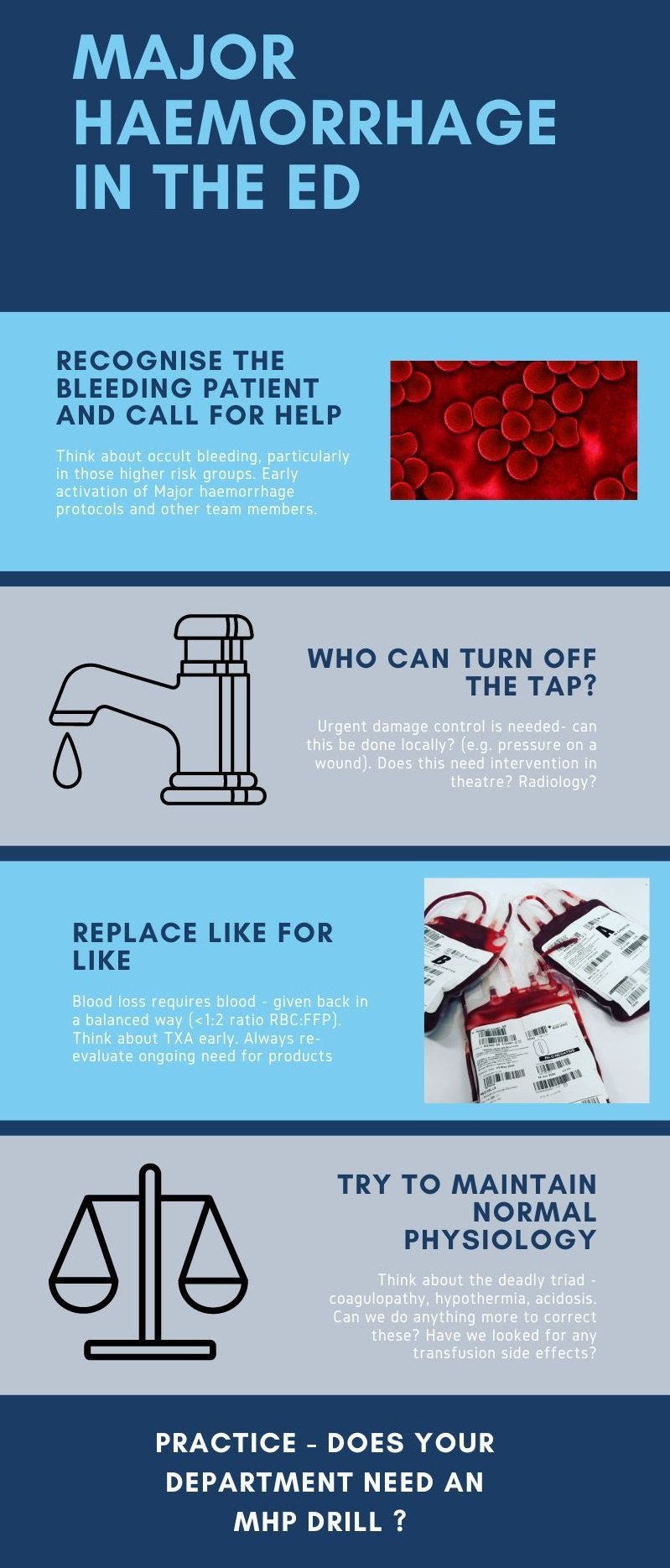
Major Haemorrhage in the Emergency Department
Recognition, Control, and Damage Control Resuscitation
Major haemorrhage remains one of the most time-critical emergencies encountered in the Emergency Department (ED). In England and Wales alone, approximately 4,700 cases of traumatic major haemorrhage are reported annually, and outside trauma centres, a patient presents to hospital with a gastrointestinal bleed every six minutes. Survival depends not on isolated interventions, but on early recognition, decisive senior leadership, and coordinated team-based resuscitation.
This article summarises current best practice in haemorrhage management, aligned with guidance from RCEMLearning, the British Society for Haematology (BSH), the American Society of Hematology (ASH), and high-quality FOAM resources such as Life in the Fast Lane (LITFL).
Consultant-level Final FRCEM SBA demo questions related to this topic are available at:
1. Recognise Major Haemorrhage Early
Do not wait for hypotension
Major haemorrhage is best defined pragmatically as life-threatening bleeding likely to require massive transfusion. While volumetric definitions exist (e.g. loss of one circulating blood volume within 24 hours), they are of limited value at the bedside and should not delay action.
High-risk clinical contexts
Maintain a low threshold for major haemorrhage in patients with:
Ruptured abdominal aortic aneurysm (AAA)
Upper or lower gastrointestinal bleeding
Obstetric haemorrhage
Recent surgery
Anticoagulant use (including DOACs)
Major trauma, particularly elderly “silver trauma”
RCEMLearning provides excellent summaries on silver trauma and anticoagulation reversal which are strongly recommended for further reading:
👉 https://www.rcemlearning.co.uk
Why vital signs mislead
Hypotension is a late sign
Absence of tachycardia does not exclude severe haemorrhage
Some patients exhibit relative or paradoxical bradycardia, likely vagally mediated and potentially reversible
Elderly trauma patients demonstrate worse outcomes with SBP <110 mmHg and HR >90, even when values appear “normal”
In pregnancy, >35% of circulating blood volume may be lost before classic signs develop due to increased cardiac output and plasma volume
Practical adjuncts
FAST: high specificity, but not a rule-out test
Pan-CT: early identification of occult bleeding in trauma
Lactate: levels >4 mmol/L correlate with mortality; clearance is prognostic
Haemoglobin: may be normal early — do not be falsely reassured
Early group & save / cross-match, ideally before donor blood is administered
2. Control the Bleeding — “Turn Off the Tap”
Calling for help is leadership, not failure
Once major haemorrhage is suspected:
Escalate immediately to senior surgical, orthopaedic, obstetric, or endoscopy teams
Involve anaesthetics and critical care early
Consider interventional radiology where appropriate
Immediate ED actions
Direct pressure and haemostatic dressings
Tourniquets when indicated
Pelvic binders and fracture splintage
Ligation or suturing of visible bleeding vessels
3. Damage Control Resuscitation (DCR)
Prevent the lethal triad before it declares itself
DCR aims to avoid the irreversible spiral of:
Hypothermia
Acidosis
Coagulopathy
Core components
Permissive hypotension
Balances tissue perfusion against clot disruption and dilution
Evidence is limited; targets must be individualised
Pragmatic adult target: MAP ≈65 mmHg
Not practiced in children, where hypotension is often peri-arrest
Early damage control surgery
Abbreviated, lifesaving procedures to arrest haemorrhage
Definitive surgery follows once physiology is restored
4. Replace Like for Like — Blood with Blood
Crystalloid is not resuscitation in haemorrhage
Early activation of the Major Haemorrhage Protocol (MHP) allows timely access to blood products, recognising unavoidable delays (e.g. FFP thawing ~20 minutes).
Tranexamic acid (TXA): use with precision
Trauma: TXA within 3 hours reduces mortality
1 g IV bolus, followed by 1 g infusion over 8 hours
GI bleeding: no mortality benefit and possible harm (HALT-IT trial)
Not recommended by BSH
Authoritative guidance:
BSH Major Haemorrhage Guideline:
ASH transfusion resources:
Balanced transfusion
BSH guidance supports:
1:1 RBC:FFP in trauma
No worse than 1:2 in most major haemorrhage
Some centres use 1:1:1 (RBC:FFP:platelets)
Early coagulation testing is useful, but treatment must not be delayed awaiting results.
5. Monitor and Mitigate Transfusion-Related Harm
Key physiological risks
Hypocalcaemia (citrate toxicity): monitor frequently on VBG/ABG
Hyperkalaemia: especially with older stored blood
Hypothermia: ensure blood warmers and rapid infusers are functioning
TRALI and TACO: particularly in elderly or comorbid patients
Human factors
Allocate a team member to:
Track blood products
Ensure prescription and traceability
Coordinate communication with the blood bank
Early stand-down of MHP if no longer required preserves resources and improves safety.
6. Actively Prevent the Lethal Triad
Hypothermia
Minimise exposure and remove wet clothing
Forced-air warming where available
Continuous core temperature monitoring
Warm all blood products
Acidosis
Restore perfusion with haemostatic resuscitation
Avoid large crystalloid boluses
Optimise oxygenation and ventilation
Coagulopathy
Assume it is present
Laboratory tests lag behind physiology and are unreliable in hypothermia
Treat empirically with balanced blood products
Engage haematology early
Use TEG/ROTEM where available for targeted therapy
Acute Traumatic Coagulopathy (ATC) is a distinct, early entity driven by endothelial dysfunction, protein C activation, and hyperfibrinolysis, and must be managed aggressively from the outset.
Key Take-Home Messages
Normal vital signs do not exclude major haemorrhage
Early recognition and escalation save lives
Blood replaces blood — crystalloid is harmful
Prevent the lethal triad rather than reacting to it
Human factors and role allocation matter as much as physiology
The British Society for Haematology recommends regular major haemorrhage “fire drills” — a high-impact, low-cost quality-improvement intervention for any ED.
🔗 Further Learning & Exam Preparation
RCEMLearning: https://www.rcemlearning.co.uk
BSH Guidelines: https://b-s-h.org.uk
ASH Education: https://www.hematology.org
LITFL Massive Haemorrhage: https://litfl.com/massive-transfusion-protocol/
Final FRCEM SBA demo questions & consultant-level packs:
👉 https://www.frcemstudyzone.co.uk