
Preparing for the Final FRCEM Single Best Answer (SBA) examination is one of the most important milestones for doctors training in Emergency Medicine in the United Kingdom. The exam is designed to assess whether candidates possess the clinical knowledge, decision-making ability, and guideline-based management skills expected of a future Emergency Medicine consultant.
For many candidates, the Final FRCEM SBA represents the most challenging theoretical component of Emergency Medicine training. However, understanding the structure of the exam, the curriculum blueprint, and the best preparation strategies can significantly improve your chances of success.
The Final FRCEM SBA is a knowledge-based written examination set by the Royal College of Emergency Medicine (RCEM). It is mapped directly to the Emergency Medicine 2021 Curriculum and assesses the ability of candidates to apply clinical knowledge to realistic Emergency Department scenarios.
Unlike simple recall-based examinations, the Final FRCEM focuses on clinical reasoning and evidence-based practice. Candidates must interpret complex clinical information and select the single best management decision.
Typical exam scenarios require candidates to analyse:
This ensures that the exam reflects real-life Emergency Medicine decision making.
More information about exam eligibility, booking, marking schemes, and results can be found on the official RCEM examination pages.
The Final FRCEM SBA exam consists of 180 Single Best Answer questions.
The examination is divided into two papers.
Paper Questions Time
Paper 1 | 90 SBA questions | 2 hours
Paper 2 | 90 SBA questions | 2 hours
A one-hour break is provided between the two papers.
Each question presents five possible answers, and candidates must select the single most appropriate option.
The questions are written in clinical scenario format, reflecting real Emergency Department cases.
The examination blueprint follows the Specialty Learning Outcomes (SLOs) defined in the RCEM 2021 curriculum.
This domain covers the majority of everyday Emergency Department presentations.
Common topics include:
Because Emergency Departments see a wide range of undifferentiated presentations, this section represents one of the largest components of the exam.
This section focuses on critically ill patients and life-saving interventions.
Key topics include:
Candidates must be very familiar with Resuscitation Council UK guidelines.
Trauma management forms a major part of Emergency Medicine practice.
Common topics include:
Many questions are based on ATLS principles.
Paediatric emergencies form a significant part of the exam.
Topics include:
Candidates must understand age-specific physiology and safeguarding principles.
These questions test knowledge of important Emergency Department procedures, including:
These questions assess professional judgement and ethical decision-making.
Topics include:
Candidates must demonstrate knowledge of:
Candidates must understand:
Topics include:
Understanding how RCEM constructs SBA questions is one of the most effective ways to improve exam performance.
RCEM questions follow a consistent structure.
Each question begins with a short Emergency Department scenario.
Typical features include:
The information provided may contain distractors, which mimic real clinical complexity.
The lead-in asks candidates to identify the single best answer.
Common formats include:
Each question provides five answer options.
The options are designed to be:
Only one answer represents the most appropriate management decision.
Successful candidates usually rely on high-quality SBA question banks aligned with the RCEM curriculum.
Effective revision resources include:
Practising large volumes of realistic SBA questions helps develop pattern recognition and clinical reasoning skills.
Begin by reviewing the RCEM curriculum and exam blueprint.
Focus on high-yield Emergency Medicine topics.
The SBA format requires pattern recognition and rapid decision making.
Regular practice helps candidates learn to:
Many exam questions are directly based on UK clinical guidance, including:
Understanding how guidelines apply to clinical scenarios is essential.
The exam requires answering 90 questions in 120 minutes.
Timed practice helps develop:
After each mock exam:
Targeted revision is significantly more effective than passive reading.
Successful candidates typically:
Repeated exposure to realistic clinical scenarios is the most effective way to pass the exam.
The Final FRCEM SBA examination is designed to ensure that Emergency Medicine trainees possess the knowledge and clinical reasoning skills required for modern Emergency Department practice.
Success requires:
With the right preparation strategy and consistent effort, passing the Final FRCEM SBA exam is an achievable goal.
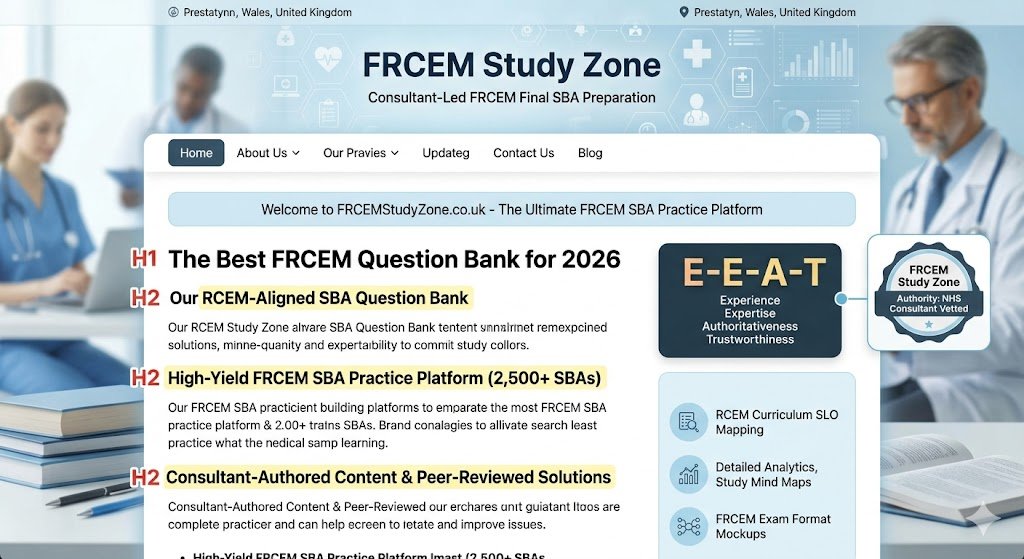
FRCEM Study Zone provides a comprehensive Final FRCEM SBA question bank with more than 2000 high-quality questions, written by experienced Emergency Medicine clinicians.
Our platform offers:
👉 Start practising today:
https://frcemstudyzone.com
https://www.frcemstudyzone.co.uk/demo-quiz